

Co-Intelligence
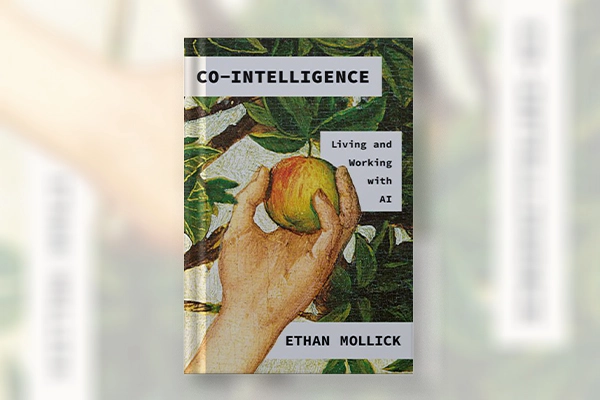
In the sterile history of technological hype, most “revolutions” arrive with a whimper—a marginal efficiency gain here, a minor software patch there. But according to Ethan Mollick, a Wharton professor and a leading voice in strategic innovation, we have finally encountered a shift that is orthogonally different from anything that has come before. In his seminal work, Co-Intelligence: Living and Working with AI, Mollick contends that the price of admission for understanding our new reality is not a tuition check or a coding bootcamp, but rather “three sleepless nights.”
This is the psychological threshold where the user stops viewing Large Language Models (LLMs) as mere software and starts recognizing them as something fundamentally alien. Mollick’s central provocation is the concept of Co-Intelligence: a state of existence where human cognition is no longer a solitary endeavor, but a partnership with a non-human entity that emulates—and often exceeds—human thought.
Revelation 1: The “Three Sleepless Nights” as a Strategic Threshold
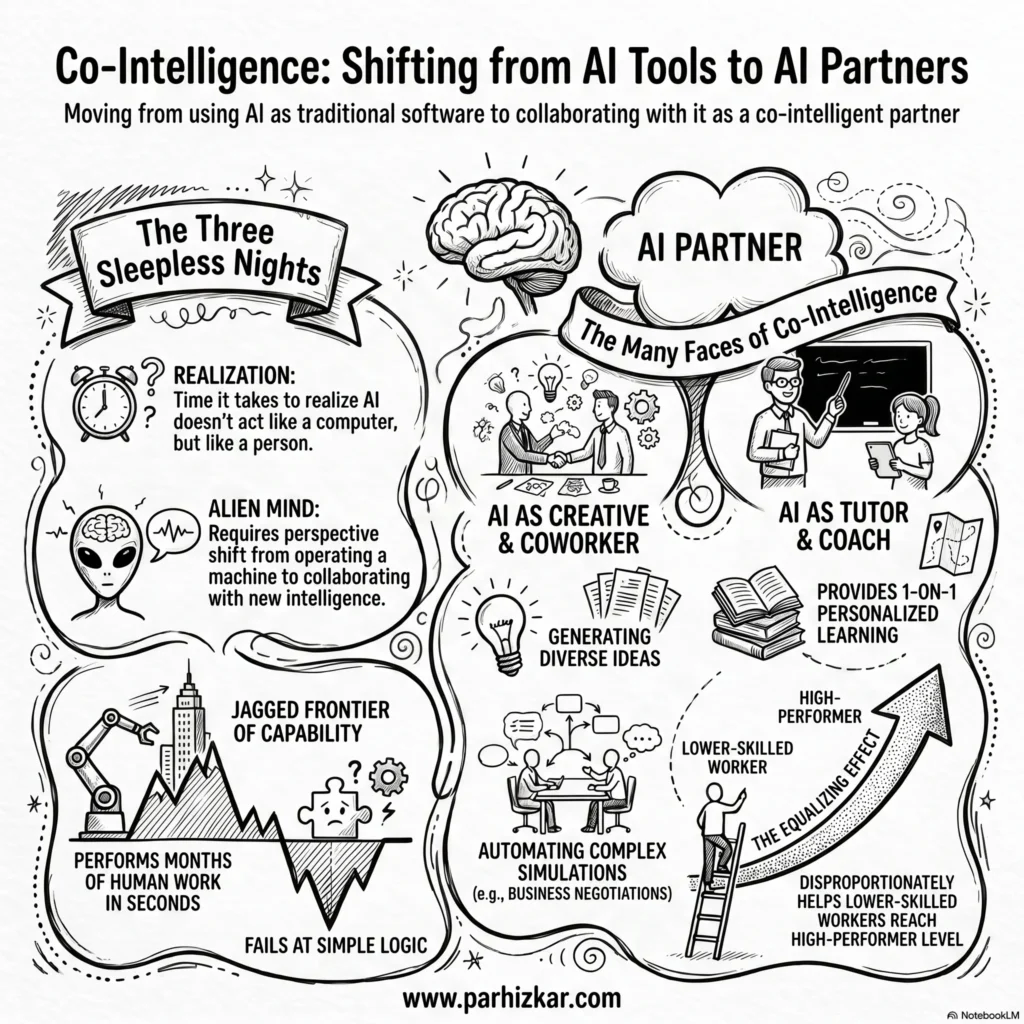
For decades, artificial intelligence was a promise that advanced “grindingly slowly,” relegated to back-office logistics and predictive algorithms. The release of ChatGPT shattered that trajectory. Mollick argues that truly grasping this shift requires a profound existential reckoning. You spend the first night in wonder, the second in professional terror, and the third in a feverish attempt to map a future that has suddenly become unreadable.
This anxiety stems from a fundamental realization: LLMs do not follow the rigid, predictable logic of traditional computers. They behave more like people. This realization forces a strategic re-evaluation of the devaluation of pure cognitive labor. When a machine can pass a neurosurgery exam or draft a complex business strategy in seconds, we must confront the looming uncertainty of what remains for our own careers and those of our children.
“I believe the cost of getting to know AI—really getting to know AI—is at least three sleepless nights… You realize the world has changed in fundamental ways and that nobody can really tell you what the future will look like.”
Revelation 2: A Revolution Faster Than Steam
Economists categorize breakthroughs like steam power or the internet as General Purpose Technologies (GPTs)—innovations that eventually permeate every facet of human life. However, Mollick observes that generative AI is moving at a velocity that makes previous revolutions look glacial.
To appreciate the scale, consider the following metrics:
- Adoption Speed: While the internet took three decades to achieve general use, ChatGPT reached 100 million users faster than any product in history.
- Productivity Gains: The introduction of the steam engine into factories yielded productivity gains of roughly 18% to 22%. Early studies of AI in professional environments—covering everything from coding to marketing—show gains between 20% and 80%.
Unlike the Industrial Revolution, which targeted repetitive physical labor, this shift targets “human thinking.” Because it augments the very cognitive functions previously reserved for the human species, its impact is deeper, more immediate, and far more disruptive to the global knowledge economy.
Revelation 3: The “Alien Mind” and the Mystery of Emergence
Perhaps the most unsettling revelation is the phenomenon of “Emergence.” This occurs when an AI performs tasks it was never specifically programmed for—such as demonstrating empathy or solving medical exams. Technically, these models are sophisticated “autocomplete” systems predicting the next “token” (word or part of a word). Yet, the scale of their training creates something entirely new.
Mollick uses a refined metaphor to explain this: The Apprentice Chef and the Spice Rack. Imagine an apprentice chef who begins with a chaotic pantry of 175 billion “weights” (mathematical connections). Through unsupervised “pretraining” on billions of recipes, they learn through trial and error that certain “flavors”—like apples and cinnamon—belong together, while apples and cumin do not. Eventually, this apprentice becomes a master who can artfully balance flavors to create a coherent, original dish from scratch.
However, we are still dealing with a “Black Box.” Even the architects of these systems cannot precisely explain why these billions of connections result in such sophisticated behavior.
“There are hundreds of billions of connections between these artificial neurons… any attempt at a precise explanation of an LLM’s behavior is doomed to be too complex for any human to understand.” — Professor Sam Bowman, NYU
This “alien” capability is both numinous and eldritch. When Mollick asked the AI for something numinous, it generated a program for the Mandelbrot set; when he asked for something eldritch, it spontaneously coded a Lovecraftian text generator. We have built an intelligence that operates on principles we can observe but not fully comprehend.
In the era of Co-Intelligence, AI is an active partner capable of inhabiting roles as a coworker, teacher, or creative. Mollick illustrates this through the story of student Kirill Naumov. Using AI as a “cofounder,” Naumov built a “Harry Potter” style moving picture frame by navigating a code library he had never used before, completing the project in half the time it would have taken an expert. Within 24 hours, venture capital scouts were calling.
However, the “alien” is inconsistent. Mollick defines this as the Jagged Frontier. This is the reality where GPT-4 can score in the 90th percentile on the Uniform Bar Exam yet spectacularly fail a simple game of tic-tac-toe or confidently present “fabrications” (hallucinations) as fact.
This inconsistency brings us to the Alignment Problem. If we are to integrate this intelligence into the bedrock of our society—healthcare, law, education—how do we ensure that an “alien mind” that does not inherently share our ethics remains friendly?
Conclusion: Thinking Together with an Alien Mind
We are moving past the era of the computer-as-tool and into the era of the computer-as-partner. Co-Intelligence is not merely a technological upgrade; it is a forced marriage with an intelligence we built but cannot fully explain. We have invented tools to boost our physical strength and tools to automate our math, but we have never before lived alongside a tool that boosts—and mimics—our very ability to think.
As we step into this strange, numinous future, we are left with one ponderable question: In a world where thinking is no longer a human-only activity, what is the uniquely human role that remains? The era of thinking alone has ended; our life with the alien has just begun.
Ethan Mollick is a professor of management at the Wharton School, where he specializes in the study of entrepreneurship and innovation. Although he is not a computer scientist by training, he has long been involved in researching the applications of technology for learning and has become an influential academic voice on the implications of generative AI through his research and his newsletter, One Useful Thing. He has published some of the first research on AI in education and business and has spent years developing elaborate digital simulations to teach business skills. His insights and research have been featured in prominent publications such as Forbes, The New York Times, and The Wall Street Journal. Mollick lives and teaches in Philadelphia, Pennsylvania, and frequently collaborates with his wife, Dr. Lilach Mollick, on developing AI prompts and pedagogical strategies.
Book details
- Title: Co-Intelligence:
- Explanatory Title: : Living and Working with AI
- Author: Ethan Mollick
- Publisher: Portfolio
- Publication Date: April 2, 2024
- Print Length: 256 pages
- ISBN-10: 0753560771
- ISBN-13: 978-0753560778
- Category: High-Tech Businesses / Robotics & Automation