

The E-myth Revisited
You started your business for freedom. Instead, you got a cage. The passion you once had for your craft—baking, coding, fixing cars—has been replaced by the relentless drudgery of tasks you never wanted to do. You work longer hours than anyone, feel trapped by the very thing you created, and realize with a shock that you haven’t built a business; you’ve just built yourself a job. This is the technician’s nightmare.
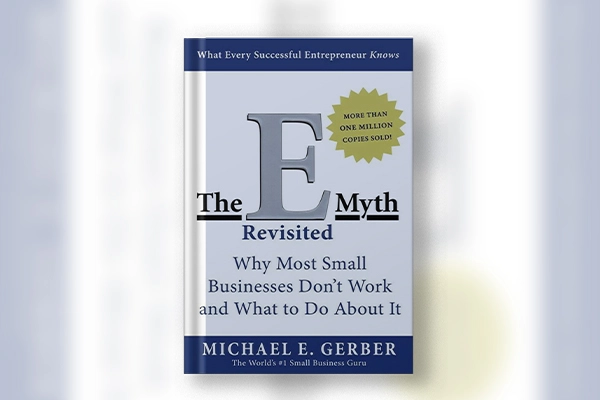
It’s a nightmare grounded in a harsh reality. Every year, over a million people in this country start a business. According to the statistics, within five years, more than 80 percent of them will have failed. In his foundational book, The E-Myth Revisited, Michael E. Gerber diagnoses this all-too-common plight and offers not just advice, but a lifeline. He argues that most small businesses fail not because of external factors, but because of a fundamental misunderstanding of what a business is and how it should be built. This article distills the six most impactful and counter-intuitive truths from his work that will permanently change how you see your business.
1. You’re a Victim of the “Fatal Assumption”: A Core E-Myth Revisited Concept
The root cause of nearly every small business failure is a single, dangerous belief that Gerber calls the “Fatal Assumption.”
The Fatal Assumption is: if you understand the technical work of a business, you understand a business that does that technical work.
This assumption is so dangerous because it’s simply not true. Being a great baker is completely different from knowing how to build a business that bakes. Being a brilliant mechanic or a gifted programmer has almost nothing to do with building a scalable, profitable auto repair shop or software company. The skills required for the technical work are not the same skills required to build the enterprise.
This is perfectly illustrated by the story of Sarah, who started her pie shop, “All About Pies,” because she loved baking. Three years later, the love was gone. One morning, standing in her shop at 7 A.M. after having been there since three, she kicked the huge black oven in front of her. “Damn!” she exploded. “Damn, Damn, Damn!” She hated baking pies. She couldn’t stand the thought, the smell, or the sight of them. She felt a terrible sense of loss—not just for the craft she once loved, but for her very self. Her dream had become a frustrating, all-consuming job she despised, all because she fell for the Fatal Assumption.
2. You’re Not One Person, You’re Three (and the Wrong One Is in Charge)
The “Fatal Assumption” doesn’t just create an external business problem; it creates an internal war. According to Gerber, every business owner is actually three competing personalities, and making that fatal assumption is what allows the wrong one to seize control.
To understand this internal conflict, consider Gerber’s brilliant analogy of The Fat Guy and The Skinny Guy. The Skinny Guy wakes up one day, disgusted, and throws out all the junk food. He buys running shoes, vows to get up at 5 A.M., and dreams of the Boston Marathon. He is in complete control. But a few days later, after a disappointing weigh-in on a cold, rainy morning, someone else is in his body: The Fat Guy is back. He doesn’t want to run; he wants to eat. The marathon is forgotten, and The Fat Guy is running the show again. The problem is that when you’re The Skinny Guy, you’re always making promises for The Fat Guy to keep. This is the same war raging inside you.
The Technician
The Technician is the “doer.” This is the personality that loves the hands-on work, lives in the present, and believes, “If you want it done right, do it yourself.” This is the personality that, armed with the Fatal Assumption, starts the business.
The Manager
The Manager is the pragmatist who craves order, planning, and predictability. The Manager lives in the past, building neat, orderly systems to maintain the status quo and clean up the messes left by others.
The Entrepreneur
The Entrepreneur is the visionary. This is the dreamer who lives in the future, thrives on change, and sees opportunities everywhere. The Entrepreneur is the strategist who is constantly asking “What if?” and creating the vision for the business.
The core problem, and the direct result of the Fatal Assumption, is that the typical small business owner becomes a mix of “10 percent Entrepreneur, 20 percent Manager, and 70 percent Technician.” Because the Technician is at the helm, the business stalls. The owner gets stuck doing the work—making the pies, fixing the widgets—instead of building the business that does the work.
3. If Your Business Depends on You, You Don’t Own a Business—You Have a Job
Pay close attention here. This insight is where most owners have their first true “aha” moment.
When the Technician takes the lead, they don’t create a business; they create a job for themselves. The work they once loved becomes a series of endless chores. Their dream of freedom becomes a prison where they are the sole warden and inmate. Gerber captures this critical distinction with a powerful and sobering quote:
If your business depends on you, you don’t own a business—you have a job. And it’s the worst job in the world because you’re working for a lunatic!
This is one of the most important insights for any owner seeking genuine freedom and scalability. The purpose of a business is to serve your life, not for your life to be consumed by your business. If the business can’t run without you, it has no value beyond the labor you put into it. It isn’t an asset; it’s a trap.
4. The E-Myth Revisited’s Central Idea: Your Business Is the Product
The true paradigm shift offered in The E-Myth Revisited is the idea of the “Franchise Prototype.” This means you must stop thinking that your product is the commodity you sell (pies, haircuts, consulting) and realize that your business itself is the product.
Gerber uses the example of Ray Kroc and McDonald’s. Ray Kroc’s genius was realizing that his true customer wasn’t the person eating the hamburger, but the franchisee buying the business. To that customer, the only question that mattered was, “Does it work?” Therefore, the business itself had to become a foolproof product. He designed and built a business system that worked so predictably and efficiently that he could sell that system to franchisees. It was a business that could run without him, delivering a consistent result every single time, regardless of who was operating it.
Every business owner must adopt this mindset. Your goal—your new obsession—must be to design your business as a self-sufficient product, a prototype that could be replicated 5,000 times and work perfectly every time.
5. The Golden Rule: Work On Your Business, Not In It
This is the mantra that must become the center of your universe. Working in your business means doing the technical, tactical work: baking the pies, taking the sales calls, writing the code. Working on your business means doing the strategic work: building the systems, refining the processes, and creating the “Franchise Prototype.”
To start, Gerber instructs you to apply the Franchise Prototype as a thought experiment for your own business. Ask yourself these critical questions:
- How can I get my business to work, but without me?
- How can I get my people to work, but without my constant interference?
- How can I systematize my business so the 5,000th unit would run as smoothly as the first?
- How can I own my business and still be free of it?
Answering these questions forces you to shift your perspective from that of a Technician doing the work to an Entrepreneur building a valuable asset.
6. The Most Counter-Intuitive Rule: Build Systems for Ordinary People
The final surprising truth challenges a deeply held belief among many business owners. Gerber’s rule for building the Franchise Prototype is: “The model will be operated by people with the lowest possible level of skill.”
At first glance, this sounds harsh, but it is not about devaluing people. It is about creating systems that are so brilliant, clear, and effective that ordinary people can achieve extraordinary results. This is the McDonald’s model in action: a brilliant system that allows ordinary high school students to produce an extraordinary, consistent result worldwide.
Relying on “highly skilled people” or experts leads to what Gerber calls “Management by Abdication.” The business becomes dependent on the whims, moods, and demands of these indispensable superstars. When they leave, the business falls apart.
In contrast, a systems-dependent business forces the owner to innovate. It compels you to build a truly robust enterprise where the system, not any single person, guarantees a consistent, high-quality result. This is the ultimate key to creating a business that is truly scalable and independent of its owner.
Conclusion: From Technician to Entrepreneur
The journey outlined in The E-Myth Revisited is a profound transformation—from being a Technician trapped in a job of your own making to becoming an Entrepreneur who has built a true business. The core message is that to change your business, you must first change your perspective. You must stop identifying with the work and start seeing your business as a separate entity—a product to be designed, built, and perfected.
As you step back and begin this process, ask yourself one question: What is the single most important system you could start building on your business today to begin buying back your freedom?
Michael E. Gerber is widely recognized as a true legend of entrepreneurship, famously called “the World’s #1 Small Business Guru” by Inc. Magazine. Over 40 years ago, he began addressing a critical need in the market: helping small businesses primarily owned by people with technical skills but lacking essential business acumen. He is the author of the international bestseller The E-Myth Revisited and serves as the Founder, Chairman, and CEO of E-Myth Worldwide, which he established in 1977. Through his company and his extensive “E-Myth” book series, Gerber has assisted hundreds of thousands of small business owners and entrepreneurs in successfully transforming their operations into world-class systems.
Book details
- Title: The E-Myth Revisited
- Explanatory Title: : Why Most Small Businesses Don’t Work and What to Do About It
- Author: Michael E. Gerber
- Publisher: Harper Business
- Publication Date: March 3, 1995
- Print Length: 288 pages
- ISBN-10: 9780887307287
- ISBN-13: 978-0887307287
- Category: Business Management / Entrepreneurship / Leadership & Motivation