

Who Not How
Do you ever feel overwhelmed, buried under a to-do list that never seems to shrink? The default question for most ambitious people is, “How do I get this all done?” This approach, however, often leads to burnout and a life of chipping away at goals instead of achieving massive results.
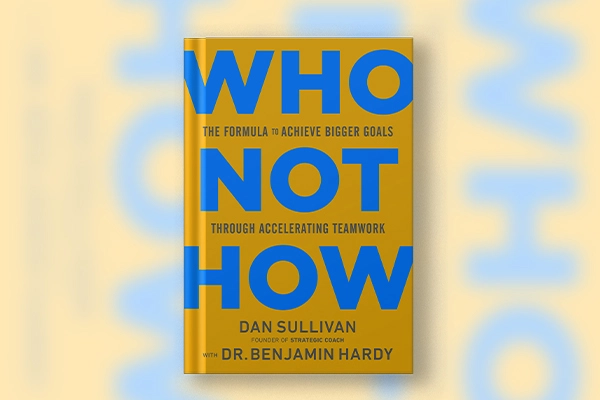
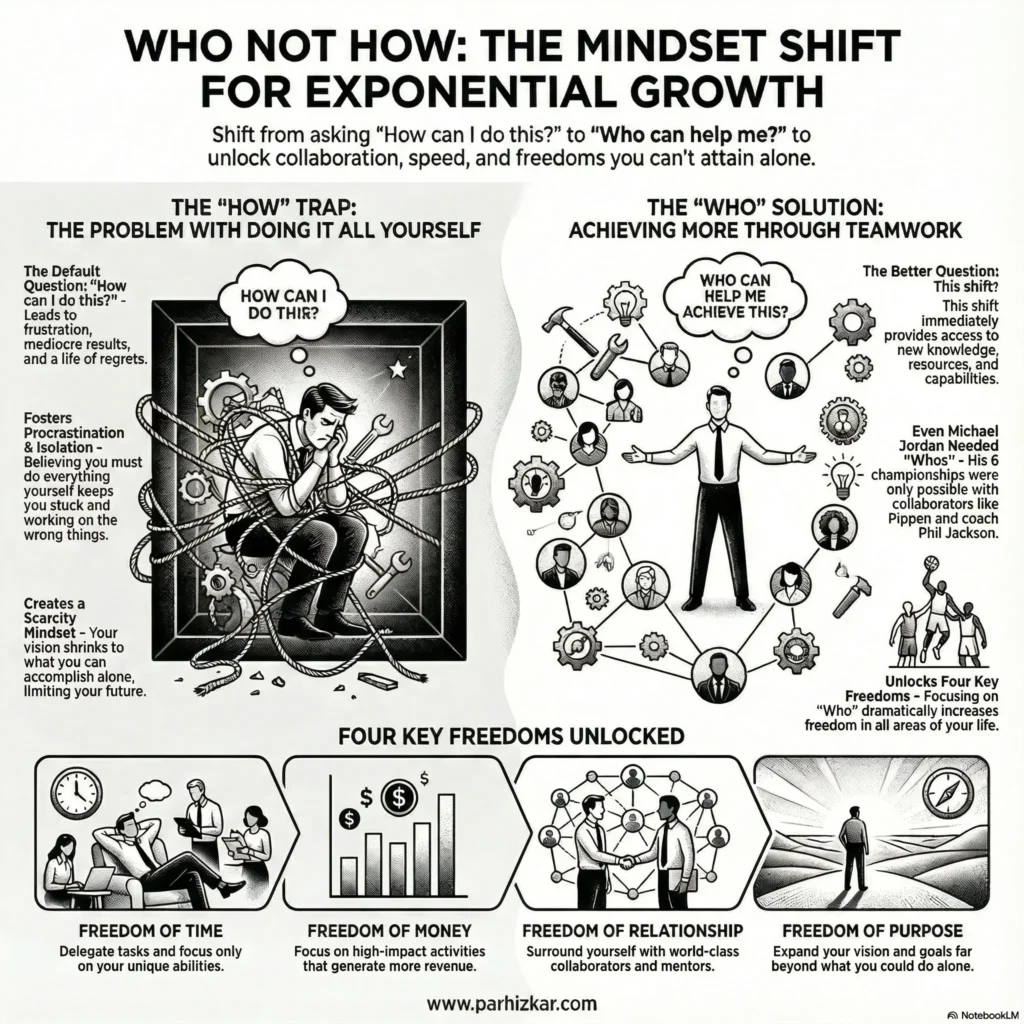
Dan Sullivan and Dr. Benjamin Hardy, in their book Who Not How, propose a fundamental mindset shift that acts as an escape from this trap. The core idea is simple: instead of asking “How?”, successful people ask “Who?”. This isn’t just a tactic for reducing stress; it’s a core business strategy for unlocking exponential growth. It’s the difference between linear progress (what you can do) and the exponential leaps possible through your network. This article distills five of the most surprising principles from their work to help you achieve your goals faster and with more freedom.
1. Procrastination Isn’t Laziness—It’s a Signal to Find Your ‘Who’
Traditionally, we view procrastination as a character flaw. It carries damaging psychological impacts, including increased feelings of shame, guilt, and diminished well-being. But the “Who Not How” philosophy offers a counter-intuitive perspective: procrastination is a form of wisdom.
It’s a powerful signal that your goal is ambitious and meaningful, but you currently lack the capability or knowledge to achieve it on your own. Instead of a sign of laziness, it’s an indicator that you need support. Procrastinating on a big goal is your mind telling you that you’re not the right person to execute every step of the plan.
“You pile up enough tomorrows, and you’ll find you are left with nothing but a lot of empty yesterdays.” —Meredith Willson
The solution isn’t to force yourself through the mental block. It’s to immediately stop asking, “How can I do this?” and pivot to asking, “Who can help me with this?” This simple shift is the key to killing procrastination and turning ambitious ideas into tangible progress.
2. True Freedom Comes from Outsourcing Your Life, Not Just Your Work
The “Who Not How” concept is not just a business tactic; it’s a life strategy that extends into every personal domain. Applying this principle beyond the office is where true freedom is created.
Consider the story of Jacob Monty, a labor and immigration attorney. He hired a driver and later used Uber to free up 90 minutes of commute time each day. This wasn’t just about saving time. It eliminated the stress of traffic and parking, reduced decision fatigue, and allowed him to arrive at high-stakes meetings more prepared and focused. He turned a stressful “How” (How do I get to my meeting?) into a simple “Who.”
Similarly, entrepreneur Tony Caldwell applied the principle to his personal health. For years, he asked, “How can I eat better?” with little success. When he finally changed the question to, “Who can help me eat better?”, the solution became obvious. He had his assistant find him a personal chef, who began cooking healthy meals for his family five days a week.
This isn’t about convenience; it’s about conserving your highest-value cognitive resources for the decisions that generate revenue and create opportunities. By finding a ‘Who’ for a $50 Uber ride, Jacob Monty ensured he was performing at a six-figure level in the meeting that followed.
3. You Only Have a Problem if Money Can’t Solve It
This principle presents a provocative idea: many of the things we label as “problems” are not problems at all if they can be resolved with a financial investment.
“If you have enough money to solve a problem, then you don’t have a problem.” —Dan Sullivan
The cautionary tale of Wes Sierk provides a powerful illustration. A millionaire, he once tried to sell his company by himself to save on fees, resulting in a failed deal and immense lost time. When he finally hired a “Who”—an investment banker—the company sold for millions more than he had attempted to negotiate on his own.
Yet the lesson didn’t fully stick. Just two weeks after selling his company, he tried to fix his own air conditioner to save a few thousand dollars. He fell off his roof, cracked his skull, and ended up in a coma for two days. This near-fatal mistake wasn’t an isolated incident of poor judgment; it was driven by the exact same scarcity mindset that had cost him millions when he refused to hire an investment banker—a ‘Who’—to sell his company. Wes’s story is a stark reminder of the danger of that mindset and the importance of valuing your time, health, and focus over small financial “costs.”
4. The “Cost” Mindset Is the Most Expensive Mindset You Can Have
There is a crucial difference between viewing help as a “cost” versus an “investment.” A cost mindset focuses on what you have to give up in the short term. An investment mindset focuses on the potential for exponential returns in the future.
Carl Castledine, the founder of Away Resorts, learned this the hard way. He spent hundreds of hours staying up all night learning to code so he could build a website for his company. After months of neglecting his CEO duties and his health, he discovered that a professional developer could have built the site for just £1,200.
But the true cost of Carl’s ‘How’ focus wasn’t just in wasted time; it was in the monumental opportunities he was missing. When he finally shifted to an investment mindset, the results were staggering. He hired a sales manager for a salary of £120,000. That “Who” generated an additional £2.5 million in profit in the first year alone. It wasn’t a cost; it was one of the best investments he ever made.
Applying the “Who Not How” framework requires seeing your “Whos” as investments in your future. They are the key to unlocking time, revenue, and opportunities that you would otherwise miss while trapped in the details of “How.”
5. Stop Competing; The Biggest Wins Are Found in Collaboration
Our culture often trains us to compete, to see others as rivals in a zero-sum game. The “Who Not How” philosophy reveals that collaboration is a far more powerful and generative path to success.
The story of Karen Nance, an attorney who wanted to write a biography of her civil rights activist grandmother, demonstrates this perfectly. After years of slow progress, she learned that Dr. Ethelene Whitmire, a history professor and expert biographer, was already writing a book on the same subject. Karen’s initial reaction was competitive—she felt she had to race to publish first.
However, she soon realized this was a losing strategy. By shifting from competition to collaboration, she could co-author the book with an expert “Who.” This partnership would result in a far better, more impactful book, completed much faster than she ever could have achieved alone. More importantly, it freed her up to focus on her other passions without abandoning her grandmother’s legacy.
“No matter how brilliant your mind or strategy, if you’re playing a solo game, you’ll always lose out to a team.” —Reid Hoffman
Collaboration doesn’t just divide the work; it multiplies the impact. It expands your purpose and makes the final outcome bigger and better than you could have initially imagined.
Conclusion: Your Future Is One “Who” Away
“Who Not How” is more than a productivity tactic; it is a transformative shift in thinking. It’s about recognizing that your biggest goals don’t depend on what you know, but on who you can connect with. It’s a commitment to focusing on results over effort and valuing collaboration over isolation.
As you move forward, ask yourself this one question:
What is the one ‘How’ in your life that, if you turned it into a ‘Who,’ would change everything?
Dan Sullivan is widely regarded as the world’s leading expert on entrepreneurship and the creator of the “Who Not How” framework. He is the co-founder of Strategic Coach®, a premier entrepreneurial coaching program that has trained over 20,000 entrepreneurs in more than 30 years. Sullivan is also the author of over 50 publications focused on achieving entrepreneurial success, reflecting his strong commitment to helping business owners reach their full potential.
Dr. Benjamin Hardy is an organizational psychologist and a best-selling author, notably of the books Willpower Doesn’t Work and Personality Isn’t Permanent. He served as the #1 writer globally on Medium.com from 2015 to 2018, with his articles reaching over 100 million readers and being featured in major publications like Forbes and Fortune. His prolific writing and expertise in organizational psychology make him a recognized voice in personal and professional development.
Book details
- Title: Who Not How
- Explanatory Title: : The Formula to Achieve Bigger Goals Through Accelerating Teamwork
- Authors: Dan Sullivan & Benjamin Hardy
- Publisher: Hay House
- Publication Date: October 20, 2020
- Print Length: 257 pages
- ISBN-10: 1401962327
- ISBN-13: 978-1401962326
- Category: Leadership & Motivation / Motivational Management / Entrepreneurship